
Sunshine Law violations, verification failures with hundreds of discrepancies and a missing polling place, and widespread resistance to candidate vetting reveal a troubling pattern commonly seen in counties influenced by the clerks’ association.
Public trust in elections requires competent, transparent officials who serve the people—not themselves or their networks. Recent examples from Osage, Vernon, and St. Charles counties expose serious problems.
City Clerk Defies Sunshine Law in Osage County (City of Linn)
City Clerk Carrie Grellner refused a citizen’s lawful request to inspect public records—meeting minutes, budgets, and ordinances—without being paid for her “time to pull them.” Missouri Sunshine Law (RSMo §§ 610.023–610.026) is clear: records must be open for inspection at no charge. Fees apply only to actual copying costs, and any staff time is covered by taxpayer-funded salaries. The clerk’s demand to “pay me for my time” misstates the law entirely—the Sunshine framework reimburses reasonable costs to protect taxpayers, not to compensate the clerk personally.
Kudos to Moody Yakker for capturing this interaction and holding local elected officials accountable to the law.
Vernon County Clerk’s Ineptitude, Vetting Resistance, and MACCEA Ties
Vernon County Clerk Adrienne Lee, running for re-election, has a documented track record of problems. After the August 2024 primary, she clashed with the Republican County Chair over the verification board required by statute. She barred the chair from participating and objected (along with the Secretary of State’s office) when Linda Rantz was named the Republican representative, falsely claiming non-residency disqualified her—despite no such requirement in the statute.
The atmosphere was hostile. Using a verification board spreadsheet designed by Rantz, nearly 400 ballot discrepancies were identified, part of an entire polling place (Walker) that had not been uploaded and showed zero votes. Lee insisted board members handwrite corrected totals from Rantz’s spreadsheet onto Lee’s preprinted results because “her printer was out of toner” (showing toner-covered hands). Notice that her software failed to properly associate candidates with offices. Unofficial results had been withheld, delaying discovery of the errors.
Examples

Walker Polling Place totals showing zero votes
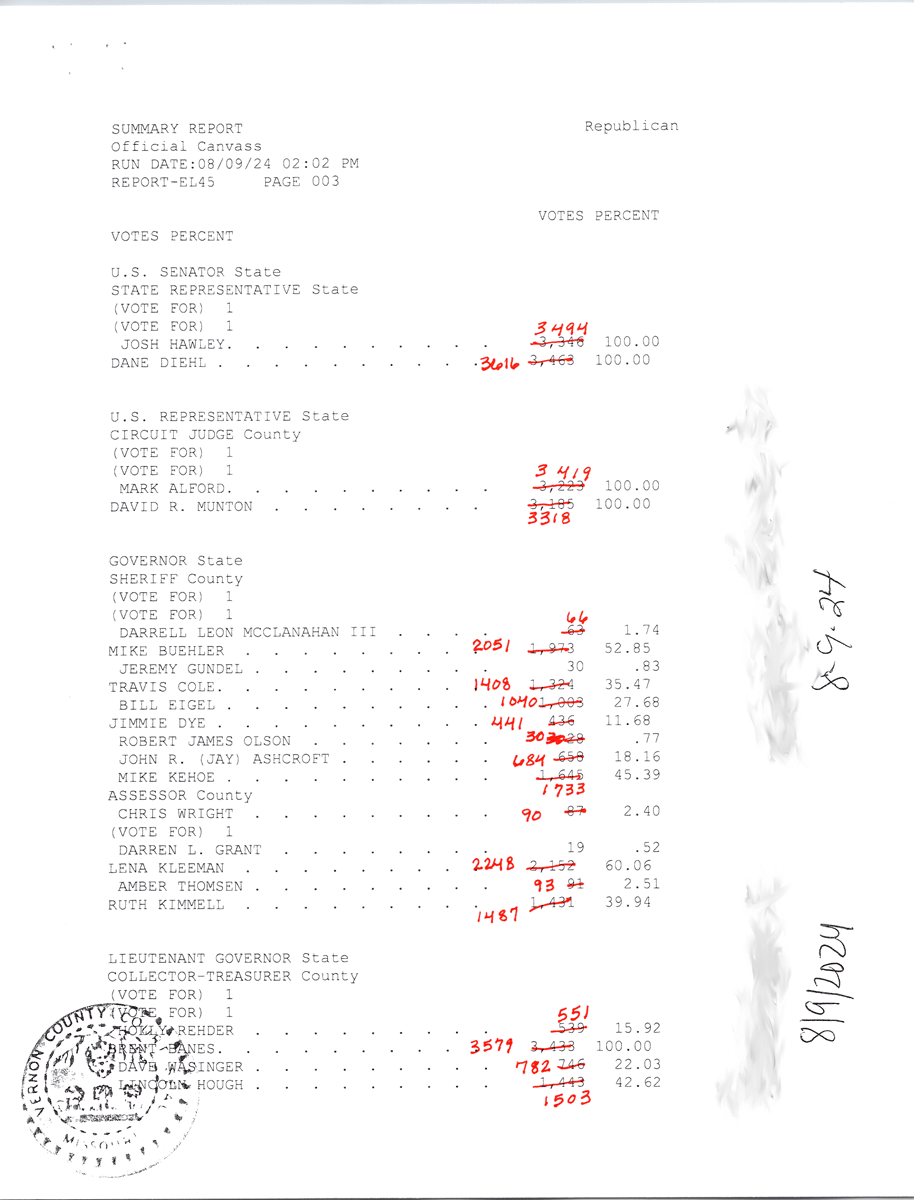
Vernon County Revised totals after discovery of discrepancies
In her campaign video (filmed in a county building), Lee proudly highlights resisting vetting. This links directly to a broader pattern: multiple counties (including Osage) placed candidates on the August ballot who failed to pay filing fees to county committees—a direct violation of Misouri election laws (RSMo 115.357.4). Osage has seven such names; an election complaint remains “under review” at the SOS while the names of those with unpaid filing fees appear on the August ballot. Another county committee filed a writ of mandamus, but faced apparent judicial resistance. These coordinated refusals to enforce vetting and filing requirements appear driven by influence from the Missouri Association of County Clerks and Election Authorities (MACCEA).
St. Charles County Election Director Kurt Bahr and the Clerks’ Network
Kurt Bahr, Director of Elections for St. Charles County (one of Missouri’s largest jurisdictions), actively promotes his office as a model of integrity. His materials emphasize paper ballots, post-election hand-count audits of select precincts, verification boards, and overall security. Not surprisingly, a recent election integrity graphic posted by Bahr drew glowing comments from numerous other clerks across the state. Many praised the information and highlighted how they “all work together” through the Missouri Association of County Clerks and Election Authorities (MACCEA) to keep elections secure.
This coordinated response serves as a public relations effort to convince Missouri voters that the current system is a gold standard. It is not. While Bahr’s office follows certain statutory processes, the broader clerks’ network—heavily influenced by MACCEA—has demonstrated resistance to robust candidate vetting and filing fee enforcement in multiple counties. MACCEA, as a lobbyist organization, advocates for the collective interests of county clerks and election authorities rather than maximum transparency or independent public oversight. The echo chamber effect creates an illusion of security while shielding systemic weaknesses from meaningful reform.
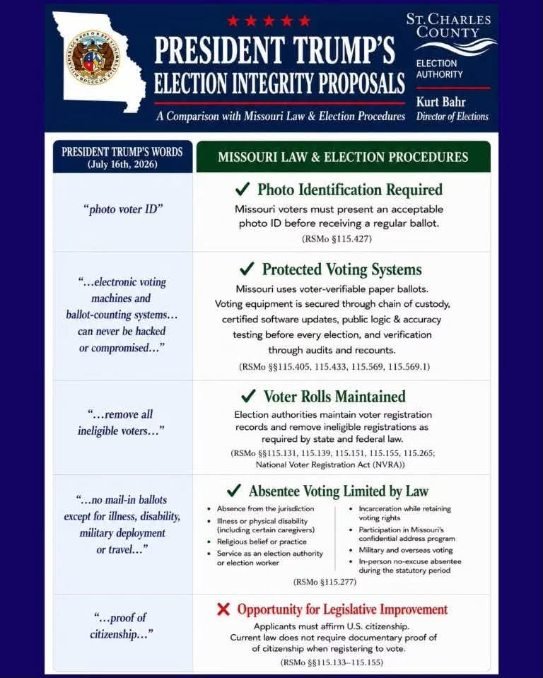
Kurt Bahr Election Integrity Graphic
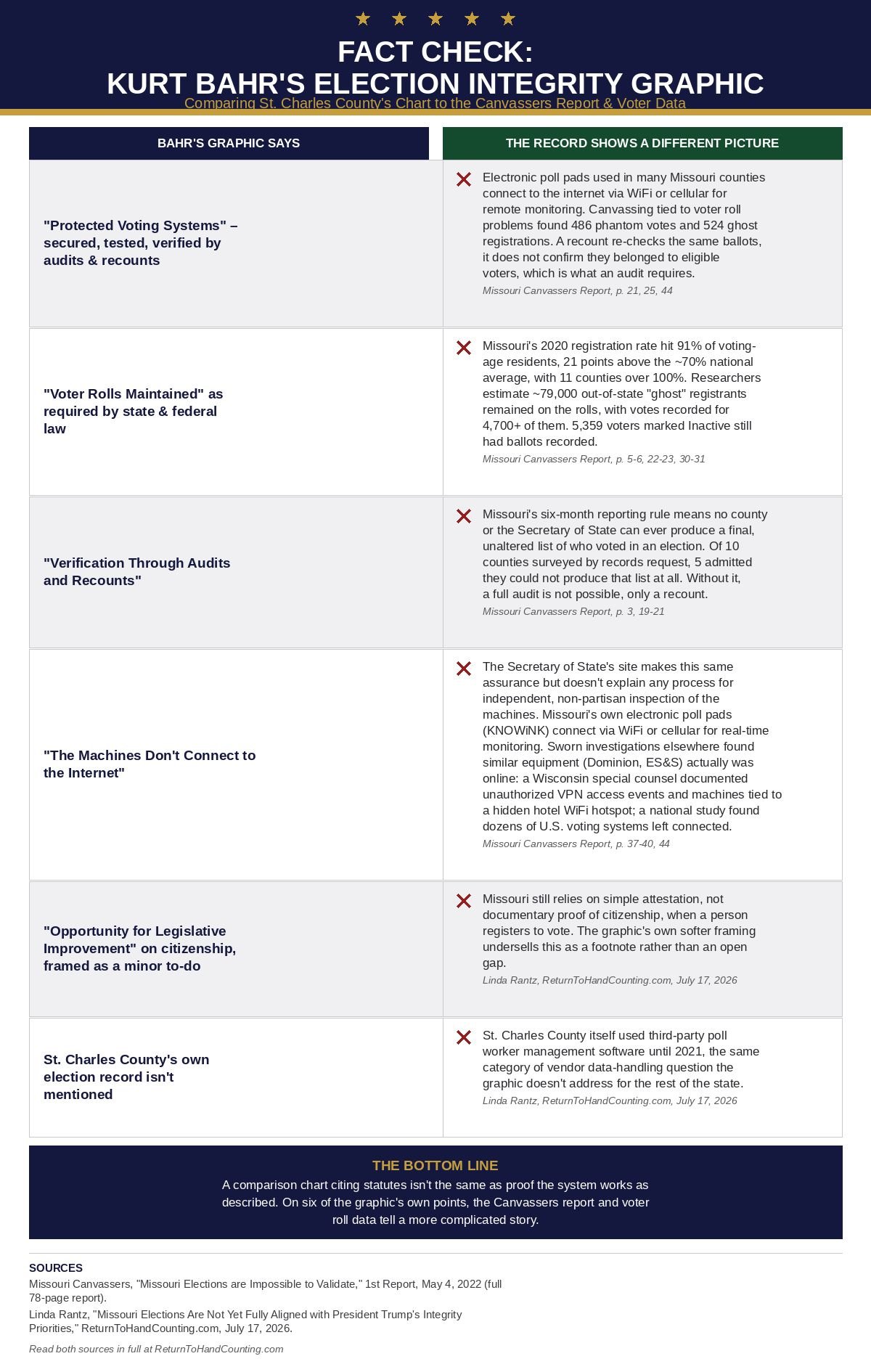
Linda Rantz Fact-Check of Kurt Bahr claims
The Common Thread
Obstruction of records, procedural failures, missing results, and systemic resistance to vetting/filing fees are protected by insider networks like MACCEA. Rural counties amplify cliques and limited oversight, but the erosion of trust is statewide. Taxpayers pay these salaries—they deserve officials who follow the law.
Hand Counting Is the Solution
Bipartisan hand counts with full public observation deliver verifiable results that machines and self-protecting processes cannot. Missouri’s paper ballots make this the gold standard for restoring confidence.
Call to Action
Tags: Adrienne Lee ▪ City Clerk ▪ clerk ▪ Kurt Bahr ▪ Linn ▪ Missouri ▪ Missouri statutes ▪ Osage County ▪ St Charles County ▪ verification board ▪ Vernon County
Your Vote Counts, so COUNT YOUR VOTE!
