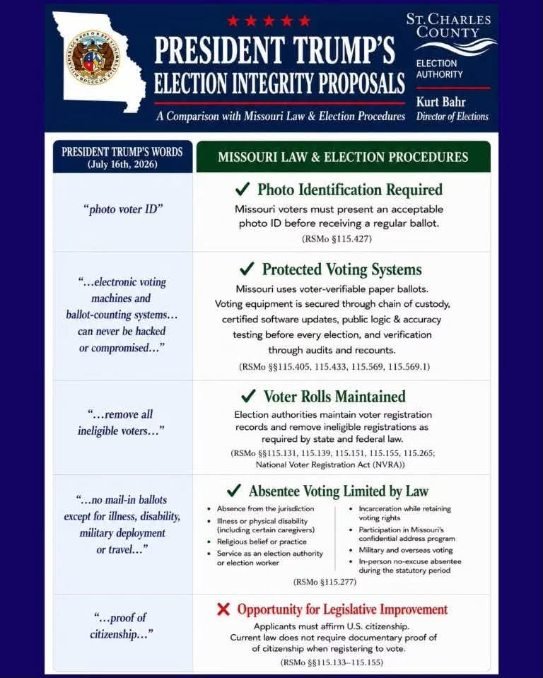
A side-by-side look at the claims in St. Charles County’s chart versus the Missouri Canvassers report and voter data
On July 17, I published a response to the graphic circulated by St. Charles County Election Director Kurt Bahr. That post examined his claim that Missouri elections already align with President Trump’s integrity priorities and pointed readers to the 2022 Missouri Canvassers report, Missouri Elections are Impossible to Validate.
Since then, a detailed fact-check graphic has been prepared that places Bahr’s claims next to findings from that report and related voter data. The comparison is worth examining.
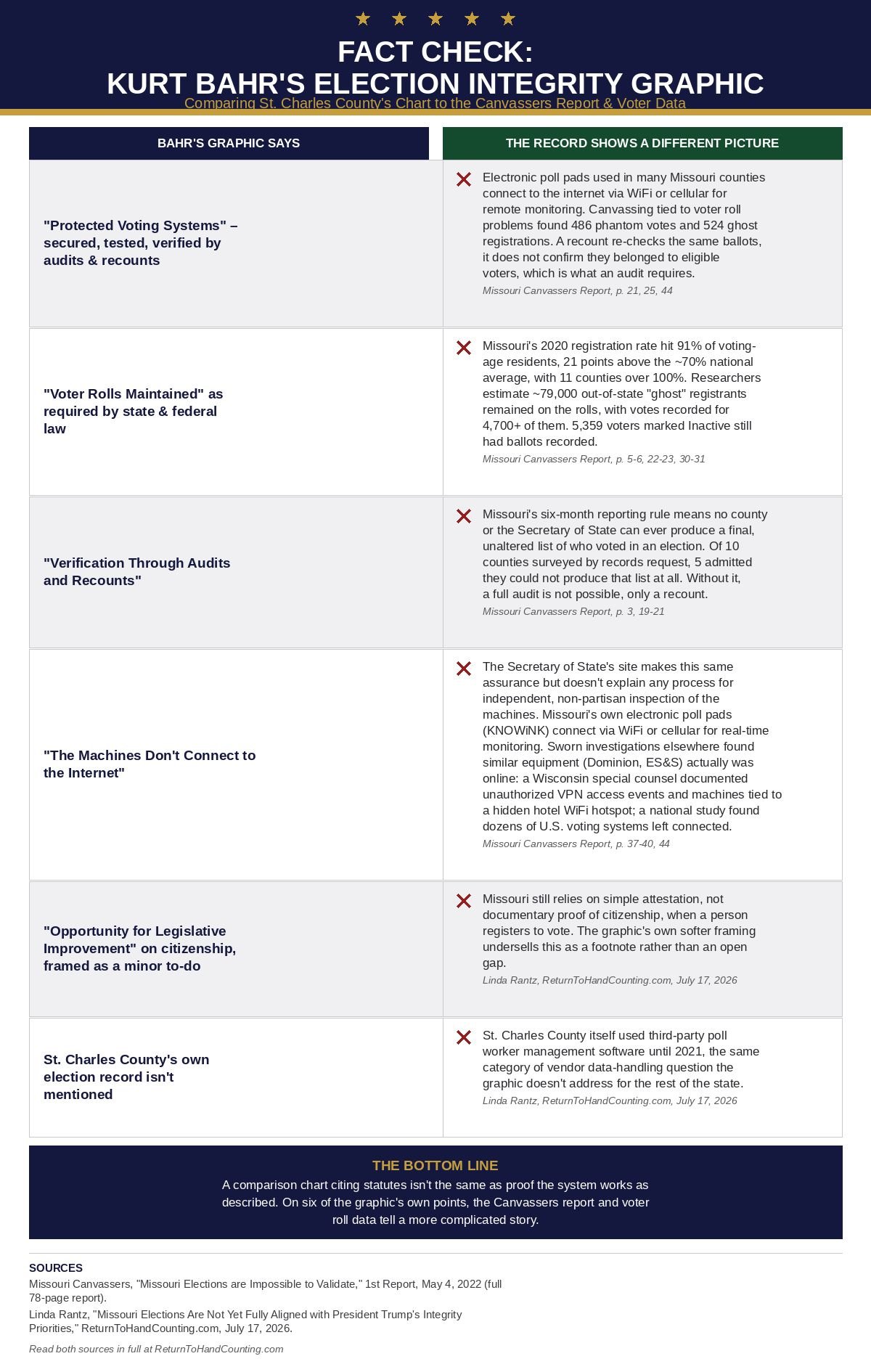
Linda Rantz Fact-Check of Kurt Bahr
What the Fact-Check Shows
The graphic reviews several of the main points in Bahr’s chart. Among the key differences:
Protected Voting Systems
Bahr’s graphic emphasizes that Missouri systems are secured, tested, and verified through audits and recounts. The record shows that electronic poll pads used in many Missouri counties are network-connected devices that transmit data in real time. Canvassing documented hundreds of phantom votes and ghost registrations. A recount re-examines the same ballots; it does not independently confirm that those ballots were cast by eligible voters.
Voter Rolls Maintained
Bahr’s chart states that rolls are maintained as required by state and federal law. The 2020 data showed Missouri’s registration rate at approximately 91% of the voting-age population — well above the national average — with multiple counties exceeding 100%. Research identified large numbers of out-of-state and inactive registrants who still had votes recorded.
Verification Through Audits and Recounts
Missouri law requires counties to report voter history within three months after an election. By the time that data is finalized, the rolls have already changed. As a result, neither counties nor the Secretary of State can produce a final, unaltered list of who voted in any given election. Without that list, a full audit of participation is not possible.
Citizenship
Bahr’s graphic frames the lack of documentary proof of citizenship as a minor “opportunity for legislative improvement.” Missouri continues to rely on simple attestation rather than requiring documentary evidence at the point of registration.
St. Charles County’s Own Record
The original graphic does not mention that St. Charles County itself used third-party poll worker management software until 2021 — the same category of vendor data-handling concern raised more broadly in the Canvassers report.
The Bottom Line
A comparison chart that cites statutes is not the same as proof that the system functions as described. On several of the points Bahr highlighted, the Missouri Canvassers report and available voter data present a more complicated picture.
I encourage readers to review both the original post and the full Missouri Canvassers report. Transparency requires more than statements that everything is already in order.
Related Reading